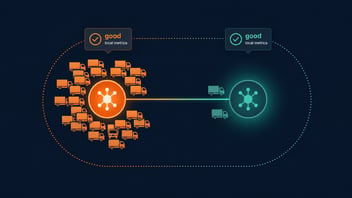
The real bottleneck in supply chains isn’t technology anymore. It’s trust

Picture a delivery that arrives four hours late. The shipper’s system says the truck was dispatched on time. The carrier’s system says pickup was held up at the shipper’s dock. Both systems are working. Both have timestamps. Neither side believes the other’s.
And so a human intercedes to determine the cause of the delay some four hours into transit, and it’s easy to determine the cause of said delay via a phone call; and once the said cause of the delay is agreed upon by both parties, it will surface again upon opening the related invoice.
Much of what has happened in the last decade of technology spending in the industry to support tracking, planning, optimization, and analytics has value at each of these points. However, a shared version of truth about events that all parties can agree on without relying on a phone call is still elusive.
Trust is also a payment problem
Look at the trust gap from a small operator’s side, and it shows up in cash flow. A fleet owner with a handful of vehicles pays for fuel, tolls, and the driver before the trip and gets paid after. If they can’t predict when the money arrives or whether an invoice dispute will hold it up, they protect themselves the way any small business would: they ask for advances, build the risk into their rate, or send their better vehicles to whoever pays on time.
The shipper sees the other half. Higher quotes, the odd truck that doesn’t show, and a carrier who suddenly wants money upfront. It’s easy to conclude the carrier base is unreliable. Each side reads the other’s caution as bad faith when both are managing the same uncertainty.
Settlement is where shared rules pay off in a way people can feel. When rates, detention terms, and surcharge triggers are in the system before the trip, and both sides can see the trip record the invoice is calculated from, payment stops being something a carrier has to chase. A short, predictable gap between delivery and payment tells a small operator something no contract clause can: this shipper does what it says. We looked at one of the most common sources of invoice arguments in our post on why most freight contracts get fuel surcharge triggers wrong.
Where trust breaks in an ordinary week
In India’s market, freight is generally booked with fleet owners, brokers, and local operators. Multiple people handle one load, and with each change of hands, the load’s records split.
For arrival times at the dock, the carriers track the arrival of their vehicles to the gate using GPS. The shipper would then track the time that the vehicles arrived at the dock door in their dock log. Since “late” is defined by the time that the clock starts at the gate versus the clock that starts at the dock door versus the clock that starts when the first carton is put off the truck, the two sides generally discount the other’s time stamp readings.
There are also issues with charges such as fuel surcharges, which have been read off a formula on one side and skimmed on the other and then queried as being incorrect when an invoice is raised. Are the charges correct? You can only find out by looking up the contract.
There are further issues around damage to goods or claims for loss, which are rarely resolved because weeks after the event the shipper has a customer complaint and the carrier has a signed Proof of Delivery, which does not show what happened to the goods when they were handed over.
Capacity promises erode more slowly. A carrier commits to ten trucks, and seven arrive. The shipper starts padding its bookings in response, a distortion the bullwhip literature calls shortage gaming. The carrier notices the padding and starts discounting requests. Each side is behaving sensibly given what the other did, and the relationship gets more defensive every month.
Underneath all of it sits a plainer question: who is actually on the other end? In a network with a long tail of small operators, confirming that a driver, a vendor, or a worker is who they say they are is the first layer of trust, and everything else rests on it. Libera’s identity verification technology sits in that layer.
Why more software hasn’t closed the gap
Unfortunately, today’s logistics software generally supports one party over the other. A shipper’s transport system and a carrier’s app, for example, will likely provide a coherent view of events based on the software provider’s data model and terminology. Two views of reality are difficult to manage, even when one of them is wrong.
Dashboards often represent the data and allow the user to draw their own conclusions on its validity. For data from within your own system, this is relatively easy, but for data from a partner via a feed, then the same discount is usually applied without anyone realizing, and that is where the delay and dispute occur.
More data on top is not going to solve the problem until all parties have agreed on the meaning of the data. Is it delivered? At what time does detention of a container start? Whose timestamp trumps the others in case of a discrepancy? These are not tech questions. The tech can then enforce agreed definitions.
What a system people can trust looks like
We think it comes down to four properties.
The first is one record that both sides see. When shipper and carrier read the same trip history, the argument moved from “whose number is right” to “what do we do about it?"
The second is rules agreed upon before the trip. Rates, surcharge triggers, detention terms, and service levels get written into the system in advance, so the invoice is a calculation and not a negotiation.
The third is decisions that explain themselves. If a carrier is awarded a load, the reason, whether cost, performance history, or capacity, is visible afterward. Carriers who can see how they’re scored argue less about whether the scoring is fair.
The fourth is a known counterparty. Identity gets checked at onboarding and again when it matters, not assumed.
This is one reason a transport management system is a natural home for trust. It sits across the whole trip: the award, the execution, and the settlement. When bid evaluation draws on the same execution history that settlement later checks, a carrier’s performance record stops being something one side asserts. Libera’s freight transport management system is built around running those stages in one system.
Trust decides how much we hand over to software
The question gets sharper as software starts to act on its own. Gartner predicts that by 2030, half of cross-functional supply chain management solutions will use intelligent agents to execute decisions autonomously. That is an analyst projection about the global market, and projections like it tend to run ahead of reality. The direction still raises an obvious point.
A planner will let software re-tender a load or reroute a vehicle only if she believes the data it’s using and can see afterward why it chose what it chose. Without both, she’ll approve every step by hand, and the automation will exist on paper only. Trust becomes the rate limiter on how much decision-making a business is willing to hand over.
One practical way to build it is to treat every human override as information. When a planner corrects a recommendation, either the system missed something or she knows something it can’t see, and a system that records the override and learns from it earns more room over time. We wrote about one version of that loop in the feedback loop that makes AI planning better every week.
Where to start
You don’t need a new platform to begin. A few moves help in almost any operation.
Agree on definitions with your top carriers. Write down what “delivered,” “on time," and “detained” mean, and which timestamp settles a disagreement. It’s a conversation, not a project.
Pick one lane where disagreements keep recurring and put both sides on the same record for it. Timing disputes and invoice mismatches are the usual candidates.
Count your disputes. Invoices that don’t match contract terms, claims opened, and calls needed to resolve a delay are a reasonable measure of how much trust you have. Most teams haven’t tallied them, and it’s worth knowing the number.
Share how you score carriers. If the scoring lives in a spreadsheet only your team sees, carriers will assume it’s arbitrary. If they can see it, they have something to act on.
Back to the late delivery. In a supply chain built on trust, nobody makes the call. The two timestamps match because both sides were looking at the same one, and the four hours get discussed as a problem to fix, not a fact to dispute. We expect the operations that pull ahead over the next few years to be the ones where fewer calls like that need to happen.