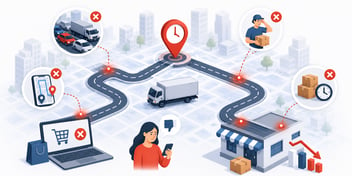
Customers rarely care why an order arrived late. They only remember that it did. For ecommerce brands, that single delay can trigger a cascade: complaints, marketplace penalties, lower seller ratings, and lost repeat business. Ecommerce fulfilment delays are rarely isolated incidents. Research shows that 42% of shoppers say they're likely to stop buying from a retailer after a failed delivery.
Source: Bringg.com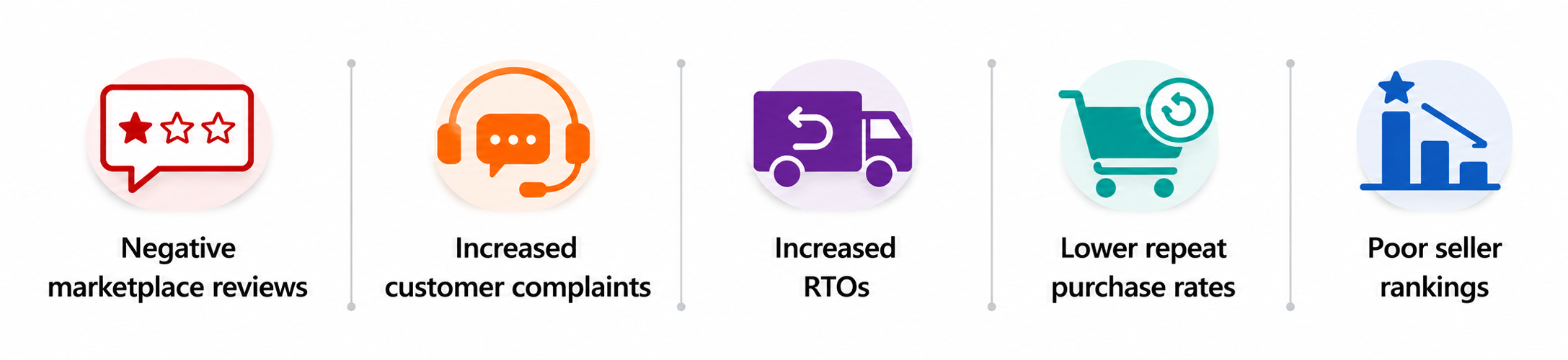
Most businesses treat late deliveries as a logistics problem and look for a courier to blame. In reality, they are almost always a symptom of deeper structural issues across inventory placement, channel visibility, warehouse operations, last-mile delivery challenges, and order orchestration. For brands competing on same-day delivery in India, these gaps are even harder to hide. Here is a breakdown of the biggest operational reasons deliveries go wrong and what can actually fix them.
The Biggest Operational Reasons Behind Late Deliveries:
1. Inventory Is Too Centralized
One of the most overlooked causes of late deliveries is not how inventory moves, it is where the inventory sits. Many brands still operate from a handful of national warehouses because centralized stock feels easier to manage. But when demand is geographically spread, centralized inventory means longer transit distances, and greater exposure to regional disruptions and festive surges, weather events, state-level logistics bottlenecks etc.
|
Operational Impact |
Business Consequence |
|
Longer line-haul dependency |
Delayed deliveries |
|
Regional stockouts during demand spikes |
Lost sales |
|
Greater exposure to route disruptions |
Poor customer experience |
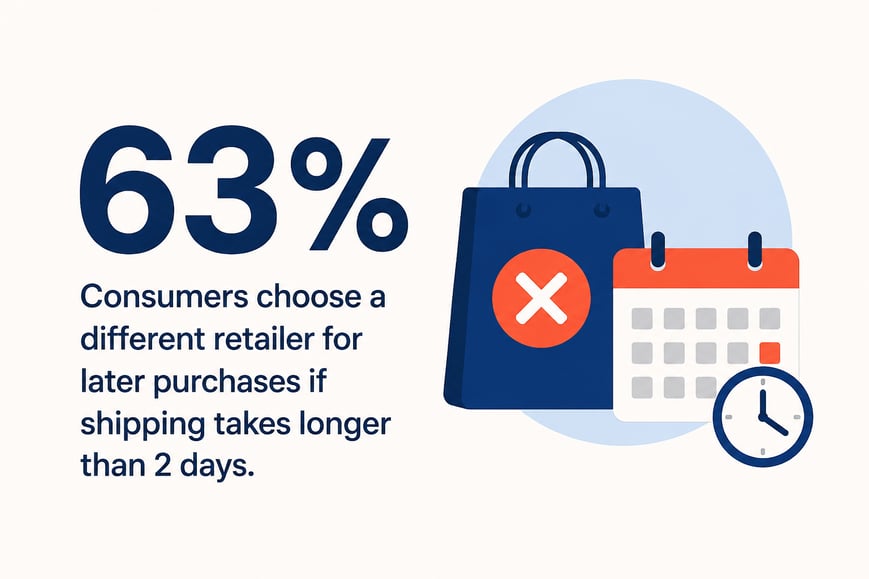 Source: capitaloneshopping.com
2. Inventory Visibility Across Channels Is Fragmented
Most omnichannel businesses still struggle with inventory synchronization. The same SKU may exist simultaneously across a D2C website, e-commerce, quick commerce dark stores, retail pools, and B2B allocations for each category, tracked separately with different safety stock buffers.
Without a unified inventory layer, common failures emerge:
• Stock out on one channel while stock sits idle on another
• Delayed order confirmation due to stock verification lags
• Artificial shortages caused by duplicated safety stock across channel
According to Gartner’s Supply Chain Research, real-time inventory visibility has become one of the strongest competitive differentiators in modern commerce. Yet most brands still treat each channel as a separate inventory silo inflating holding costs and slowing replenishment cycles simultaneously.
3. Warehouse Bottlenecks Are Delaying Dispatch
Most warehouse systems were designed for predictable retail replenishment cycles not the high-frequency, multi-channel demand patterns of modern ecommerce. According to a LocalCircles survey, urban Indian consumers increasingly rely on quick delivery for essential purchases, with many now expecting 2-hour delivery as a baseline, making logistics reliability a key differentiator for retailers. Delivery delays often begin before a shipment leaves the warehouse. As order volumes scale, operational inefficiencies in warehousing and last-mile delivery inside fulfillment centers become more visible and more costly. For order fulfillment in India, where pin code coverage and infrastructure vary widely, these inefficiencies translate directly into ecommerce fulfillment delays at the last mile.
4. Disconnected Systems Create Orchestration Failures
Most brands today already use multiple courier partners, a WMS, an OMS, marketplace integrations, and tracking tools. Yet delivery delays keep increasing. The reason is simple: each system works independently.
Customers experience fulfillment as one single journey. When systems do not communicate in real time, orchestration breaks down:
• Orders are routed to warehouses that don’t have the stock
• Courier allocation ignores real-time capacity or carrier performance data
• SLA feasibility is not verified before a delivery promise is made to the customer
What Late Deliveries Are Actually Costing You
Most brands measure delivery performance through SLA breach rates and logistics costs. What rarely gets measured is what happens to the customer on the other side of every missed promise.
1. You Lose Customers You Already Paid to Acquire
Customer acquisition in ecommerce is expensive. A single late delivery can erase that investment entirely. Repeat customers, despite making up only 21% of a brand’s buyer base, generate 44% of total revenue. Every customer lost to a poor delivery experience is not just one lost order, it is the entire future revenue stream from that customer.
2. Marketplace Ratings and Visibility Take a Hit
On e-commerce platforms, late deliveries are not just a customer problem they are also a compliance and visibility problem. It requires sellers to maintain a Late Shipment Rate (LSR) below 4%. Crossing this threshold can trigger penalties, Buy Box suppression, and, in repeated cases, account suspension. Seller performance scores are directly influenced by late shipments, cancellation rates, and return volumes. Declining scores reduce listing visibility and weaken platform trust badges.
3. Customer Support Costs Spike
Every late delivery generates downstream support load: WISMO (where is my order) queries, complaints, refund or replacement requests, and in some cases chargebacks. These costs are rarely attributed back to the original delivery failure.
Each chargeback carries processing costs, reversal fees, and the risk of payment gateway penalties at scale.
• Support ticket volume spikes during and after any delivery delay event
• Resolution costs per ticket are higher when physical intervention (refund, reship, replacement) is required
• Support overload during peak periods compounds the original operational failure
4. Brand Trust Erodes Faster Than It Builds
In a market where customers have dozens of alternatives, trust is the differentiator that advertising cannot buy back. Last-mile delivery challenges are often what customers remember most. A negative delivery experience shared on social media or marketplace reviews multiplies its impact far beyond the single order lost.
How to Fix Late Deliveries: What Actually Works
Late deliveries are a systems problem. Solving them requires rethinking fulfillment architecture, not just adding more couriers or warehouse space. Delivery delays compound when systems cannot keep up with order volume. Here is what operational improvements actually look like.
1. Distribute Inventory Closer to Demand
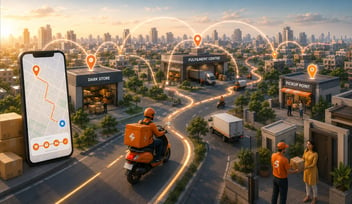
Instead of shipping everything from central warehouses, position inventory based on regional demand clusters. This reduces transit distance, line-haul dependency, and delivery exceptions in one move. It also creates the network foundation needed to support 2-hour delivery windows at scale and enables faster order fulfillment in India across diverse geographies.
• Use historical order data to identify where demand concentrates by pin code or region
• Prioritise high-velocity SKUs for distributed placement first
• Supplement central warehouses with regional hubs, dark stores, or 3PL nodes in high-demand zones
2. Unify Inventory Visibility Across All Channels
A single, real-time inventory layer across D2C, marketplace, retail, and B2B channels eliminates the overselling, stock duplication, and ATP errors that cause delays before dispatch even starts.
• Connect WMS, OMS, POS, and marketplace systems to a shared inventory source of truth
• Replace channel-specific safety stock buffers with shared safety stock logic
• Implement real-time ATP checks so delivery promises are only made when fulfilment is actually feasible
3. Modernise Warehouse Operations for Ecommerce Volumes
Warehouses designed for retail replenishment need rethinking for high-frequency ecommerce demand. Operational improvements that directly cut dispatch delays include:
• Batch picking optimised by delivery zone and courier route grouping
• Automated put away and slot allocation to reduce inbound processing lag
• Warehouse workload balancing across shifts to prevent dispatch bottlenecks during peaks
4. Invest in Intelligent Order Orchestration
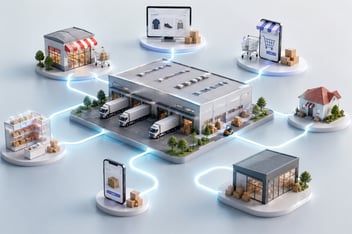
Order orchestration replaces manual routing decisions with automated, rule-based logic that selects the best fulfillment node for every order based on real-time data. Route orders automatically based on inventory availability, warehouse capacity, SLA feasibility, and courier performance. Balance workload across fulfilment nodes to prevent any single warehouse from becoming a bottleneck.
Build rerouting logic so that if one node fails (weather, capacity, downtime), orders shift automatically. For brands managing fulfillment across multiple warehouses and channels, platforms like SwiftER by ElasticRun are built around this model helping brands unify inventory, warehousing and last-mile delivery, and delivery orchestration across a distributed network rather than relying on isolated fulfillment nodes.
Late deliveries are rarely caused by a single failure. They are the result of fragmented systems struggling to manage the complexity of modern, multi-channel ecommerce.
Inventory is often concentrated in a few locations, increasing shipping distances and dependence on inter-city movement. At the same time, inventory visibility remains siloed across channels, making it difficult to allocate stock efficiently and respond to demand changes in real time. Traditional warehouses are often designed for storage rather than high velocity fulfillment, while disconnected systems create information gaps that slow execution. Together, these challenges result in delivery delays, missed delivery promises, higher logistics costs, and poor customer experiences. Ecommerce fulfillment delays that start inside the warehouse or at the last mile are often the most difficult to fix without rethinking the entire fulfillment model.
As customer expectations shift toward same-day delivery in India and next-day delivery, these inefficiencies become more apparent. Brands that consistently deliver faster are not necessarily spending more on logistics. Instead, they are rethinking fulfillment by building distributed inventory networks closer to demand centers, integrating systems for real-time visibility, and orchestrating inventory, warehousing and last-mile delivery, and transportation through a connected fulfillment ecosystem.
This is where Swifter enables brands to move ahead. Dark store operations and a technology-led logistics network, SwiftER by ElasticRun helps brands position inventory closer to demand, support same-day delivery in India and 2-hour delivery commitments, address last-mile delivery challenges at scale, and deliver faster across channels without the complexity of building and managing logistics infrastructure themselves. For brands prioritising order fulfillment in India across metros and tier-2 markets, this is what modern fulfillment infrastructure looks like.