How Intracity Delivery Delays Impact Business Sales

For any business operating across Indian cities, in retail, FMCG, food and beverage, fruits and vegetables, consumer electronics and appliances, furniture and home decor, pharmaceuticals, OEM, infrastructure, or chemical industries such as paints, getting stock from a warehouse to a store, dealer, dark store, or fulfillment node on time is one of the most routine and most consequential parts of the supply chain. It happens every day, across every city. And in India, it is still largely handled by informal vendors and brokers, unverified drivers, and verbal commitments.
That is the intracity truck problem. And unlike the more visible parts of logistics, it does not announce itself loudly. It shows up quietly, in stockouts, missed delivery windows, inflated costs, and lost festive season revenue. For businesses asking why are my deliveries late or why last mile delivery problems keep recurring, the answer often starts here.
A Market Built on Informal Trust
In most cases, there is no standard process in this market. A business calls a vendor or broker. The vendor or broker calls a driver. The driver may or may not show up. At most times, there is no contract, no tracking system, and no formal backup when things go wrong. These are among the most persistent order delay reasons businesses deal with, yet they rarely get diagnosed at the root cause. For businesses that depend on consistent stock movement, whether that is a retail store, a pharmacy counter, a dealer outlet, or a plant, this makes reliable operations difficult to sustain.
Everyday challenges businesses face with local transport vendors and brokers:
-
• No-shows and last-minute cancellations. Drivers may occasionally cancel at short notice if they receive a higher-paying assignment. When relying on a local vendor or broker, finding an immediate replacement can often be challenging, which may result in shipment delays or rescheduling for another day.
-
• No visibility once the truck leaves. When booking from a local vendor or broker, once a truck leaves the warehouse there is typically no way to trace it, no ETA, no live status. Problems surface only after they have already caused damage downstream.
-
• Vehicle mismatches. A smaller vehicle when you need a large one. A truck that cannot enter the city before 10 AM due to traffic rules. Mismatched vehicles force repeat trips and double the cost.
-
• No accountability for damage or delays. When booking from a local vendor or broker, damaged stock, missing units, no proof of delivery, no formal invoice. The warehouse team is left managing the fallout with no escalation path.
What This Costs Businesses in Practice
To understand the potential business impact, consider an illustrative example of a footwear brand selling through both retail stores and online channels across multiple Indian cities. Each week, its warehouse dispatches inventory to a network of stores and fulfillment locations. Demand tends to peak during seasonal events, while customers in select markets increasingly expect faster delivery options. In such situations, maintaining inventory visiability and ensuring timely replenishment can be critical to meeting customer expectations and avoiding stock imbalances. At the store level, a missed truck means shelves do not get restocked. Customers walk in, do not find their size or colour, and leave. The reasons for late delivery here are rarely complex: an unverified driver, no backup plan, and no escalation path. For a business with a strong walk-in customer base, this is direct, immediate revenue loss on every stockout day.
At the fulfillment level, ecommerce orders break when stock is stuck at the main warehouse instead of reaching the dark store close to the customer. An order dispatch delay at the warehouse level translates directly into a late delivery in ecommerce, one that generates a cancellation, a return, or a negative review rather than a completed sale.The same dynamics play out well beyond retail. A pharmaceutical distributor moving time-sensitive stock to retail pharmacies cannot absorb a missed truck without risking product availability and compliance. A paints or chemical business replenishing dealer counters needs vehicles matched to the load type and timed to dealer operating hours. Furniture and home decor businesses carry added risk of in-transit damage when vehicle types are mismatched to bulky loads. Consumer electronics and appliances involve high-value, lower-volume shipments where a single delayed or damaged consignment is expensive to absorb.
FMCG, food and beverage, and fruits and vegetables businesses run on high-frequency, small-batch replenishment to general trade and modern trade outlets, where a missed truck breaks the next day’s shelf availability. OEM and infrastructure businesses moving components and materials between plants, warehouses, and project sites face schedule and production risk when a single vehicle does not turn up. Across all of these sectors, the mechanics of the problem are the same: an unreliable vehicle layer creates cascading failures wherever it sits in the chain.
Festive and wedding months remain a critical demand period for footwear brands in India. RAI’s 66th Retail Business Survey reported a 12% year-on-year increase in footwear sales during the 2025 festive season. This period may also see heightened truck demand and tighter vehicle availability, making timely stock movement essential. Businesses that are unable to replenish inventory in time may risk missing sales opportunities and losing potential demand to better-prepared competitors.
The Ripple Across Fulfilment, Sales, and Customer Experience
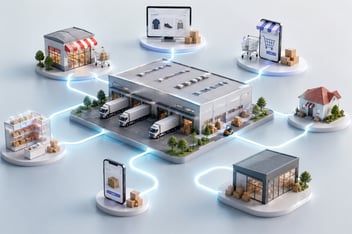
A missed truck is not a single-day problem. It sets off a chain of failures across every connected part of the operation. Warehouse operations delay at one node triggers an ecommerce delivery failure that ripples through store replenishment, dark store availability, and customer SLAs simultaneously. Omnichannel fulfilment depends on stock moving reliably between locations. Click-and-collect, ship-from-store, inter-location transfers, all of this only work when the vehicle network underneath them is functioning. Without that, multi-channel operations become impossible to coordinate at scale.
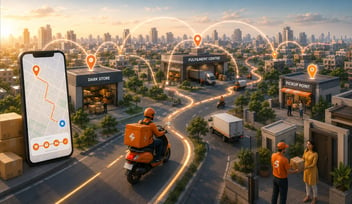
Quick commerce fulfilment introduces additional dependency. Businesses offering fast delivery hold stock in dark store nodes close to the customer. Those nodes need scheduled, reliable replenishment. One missed truck does not just delay one order, it takes down a node’s entire availability window until the next dispatch cycle. This pattern is not limited to quick commerce or retail. FMCG distributors, pharmaceutical wholesalers, and industrial suppliers depend on the same layer of vehicle reliability to keep their own downstream commitments. The financial impact is not limited to lost sales. Unplanned repeat trips, last-minute spot bookings at premium rates, and wasted driver time accumulate quickly. Logistics costs run significantly above budget, and the reliability the business pays for does not materialise.
Common failure modes in informal intracity truck operations and their retail business impact:
|
Impact Area |
Symptom |
Downstream Effect |
|
Store / dealer replenishment |
Missed truck, delayed dispatch |
Stockout, lost walk-in or dealer revenue |
|
Dark store replenishment |
No-show driver, last-minute cancel |
Broken 2-hour delivery promise |
|
Festive season logistics |
Reduced availability, informal market collapses |
Delayed stock movement, lost sales window |
|
Reverse logistics |
No proof of delivery, no vehicle records |
Unresolved damage claims, write-offs |
|
Omnichannel execution |
Unreliable inter-node movement |
Failed click-and-collect, ship-from-store |
Solving Each Layer of the Problem
The businesses that have moved past this are not doing it with better brokers or vendors. For those looking at ecommerce fulfilment problems and solutions across retail, FMCG, food and beverage, pharmaceuticals, consumer electronics, furniture, chemicals, OEM, and infrastructure supply chains, the answer lies in managed fulfillment networks that address each failure mode directly, through verified vehicle fleets, technology, and end-to-end accountability. Understanding how to reduce delivery delays at the intracity level is where this shift begins. Here is how each problem maps to a capability that already exists in the market.
Problem-to-capability mapping for managed intracity fulfilment networks:
|
The Problem |
The Capability That Solves It |
|
No-shows and cancellations with no backup |
Quick vehicle deployment with pre-matched options across vehicle types. When a booking falls through, a replacement is arranged with minimal turnaround, keeping dispatch on schedule. |
|
No visibility once the truck leaves |
A driver app used across the entire fleet enables vehicle tracing from dispatch to delivery. The warehouse team can follow the movement and act early if a delay is likely. |
|
Wrong vehicle type, repeat trips |
A wide range of vehicle types, from 3-wheelers and Tata Ace variants to 32 ft SXL and MXL trucks, means the right vehicle is matched to the load at the point of booking. |
|
No accountability for damage or delays |
Digital Proof of Delivery and document management are standard on every movement. Transparent billing runs through MIS-level client approvals, with GST-compliant invoicing throughout. |
|
Dark store and quick commerce replenishment breaking down |
Dedicated vehicles on fixed schedules, combined with scalable ad hoc capacity, keep replenishment cadences intact across all active cities without businesses needing their own fleet. |
These capabilities are not aspirational. They are already built into how ElasticRun’s intracity trucking vertical, Sprinter, operates across 11 cities in India. Each capability maps directly to the problems described above. On no-shows and last-minute cancellations: Sprinter’s strength is quick turnaround on vehicle deployment. Across its network of 3-wheelers, Tata Ace variants, and multi-axle trucks up to 32 ft, the right vehicle type is matched and deployed with minimal lead time. Businesses operating across NCR, Mumbai, Bangalore, Pune, and seven other cities can scale up or pull back capacity without the delay and uncertainty of vendor or broker-sourced arrangements.
• Visibility: Every driver on the Sprinter network uses a dedicated driver app that functions as a real-time inventory visibility platform across the movement layer, enabling vehicle tracing from the point of dispatch. The warehouse team can monitor where a vehicle is on its journey and act early if a deviation or delay is likely, helping reduce delivery SLA breach before it reaches the customer, rather than discovering the problem after the delivery window has already closed.
-
• Vehicle mismatches: Sprinter operates one of the widest intracity vehicle ranges available, from compact 3-wheelers suited to tight urban lanes to 32 ft SXL and MXL trucks for high-volume store or warehouse movements. Vehicle type is matched at booking, not improvised at the dock.
-
• Accountability: Digital Proof of Delivery is captured across the network, alongside digital documentation and GST-compliant invoicing. Billing is processed through MIS-level approvals by the client before it is finalised, helping improve cost visibility and reduce the likelihood of unexpected charges or reconciliation issues at the end of the month. A dedicated redressal desk manages exceptions, providing logistics teams with a single point of contact for issue resolution.
-
• Fulfilment coverage: Sprinter enables businesses to manage intracity transportation across 11 cities through a single logistics partner, reducing the operational burden of handling multiple regional transport vendors. A unified network, standardized processes, and centralized visibility help ensure consistent execution across locations.
-
• Deployment and capacity: Once a solution is agreed, deployment readiness planning, fleet mobilization, and go-live support run in parallel, backed by vehicle sourcing and capacity management, route and network planning, and a mix of dedicated and shared fleet solutions matched to how consistent the volume is.
-
• Day-to-day operations: A centralized operations control tower runs real-time vehicle tracking and GPS-enabled shipment visibility, backed by SLA monitoring and governance, OTIF performance management, and customer escalation management through a defined resolution path rather than an ad hoc call to the depot.
-
• Value-added services: POD collection and validation, COD collection and reconciliation, dedicated manpower deployment for loading and unloading, and a customer dashboard and reporting are available where an account needs them.
-
• Billing, reporting, and analytics: MIS and performance analytics, GST-compliant invoicing, and AR and AP management support give finance and operations teams one source of truth on cost and performance. Sprinter already serves businesses across grocery, quick commerce, FMCG, food and beverage, fruits and vegetables, furniture and home decor, consumer electronics and appliances, pharmaceuticals, OEM, infrastructure, chemicals, and B2B ecommerce. Leading quick-commerce players and large businesses across these sectors rely on the network for intracity movements that demand speed, consistency, and accountability at scale. A managed logistics model helps reduce stockouts by ensuring replenishment runs on a fixed daily schedule with confirmed vehicles. Every shipment is backed by digital documentation and a clear escalation process, eliminating the uncertainty of the traditional vendor or broker model.
Your Next Peak Season Does Not Have to Look Like the Last One
Stockouts, no-shows, vehicle mismatches, broken delivery promises. Every one of these is a solved problem when the right fulfillment infrastructure is in place. Businesses that have understood how to improve on-time delivery rate at the intracity level are not managing these issues better. They have removed them from their operating model entirely. If the question you started with was why are my deliveries late, the reasons for late delivery are usually sitting in the vehicle layer, not the warehouse or the store. If intracity truck unreliability is affecting your store or dealer replenishment, your online fulfillment SLAs, or your logistics budget, this is the right time to fix it. Not after the next missed shipment. Not after the next festive season. Reach out to the Sprinter team at ElasticRun to understand what a managed intracity fulfilment network looks like for your specific city footprint, industry, and delivery commitments.