India's e-commerce boom has fundamentally changed consumer expectations. Whether in a metro or a Tier-2 city, customers increasingly expect their orders to arrive the same day, and often within hours. Reflecting this shift, India's express parcel market is projected to reach 24–29 billion shipments by FY30 (Redseer) underscoring the growing demand for faster and more reliable delivery experiences. Delivering on that promise requires far more than just speed. Behind every same-day delivery is a complex network of fulfilment centres, dark stores, transportation hubs, routing technology, and last-mile delivery operations working together in real time to move millions of parcels across the country.
This article explores how these fulfilment networks operate at scale, the infrastructure that powers them, the last-mile delivery challenges India's brands continue to face, and why last-mile delivery efficiency has become one of the most important competitive advantages in Indian retail.
1. What is Same-Day Delivery and Why Does It Matter in India?
The logistics industry defines same-day delivery as orders reaching customers on the same day they are placed. It sits within a broader delivery-speed spectrum, ranging from 10-minute and 2-hour quick-commerce fulfilment to next-day standard delivery. Today, it has become an expectation rather than an exception for urban shoppers across categories such as fashion, electronics, pharmaceuticals, and groceries.
It matters because Indian consumers are increasingly factoring delivery speed into their purchase decisions. Brands that cannot offer faster delivery options through their own channels risk losing orders to marketplaces and quick commerce platforms that can. Speed is no longer just a differentiator, it has become an important retention lever.
The broader market trajectory reinforces this shift. According to the EICI–KPMG Express Logistics Industry Report, India's express logistics sector is projected to reach USD 18–22 billion by FY30 and support 6.5–7.5 million jobs, reflecting the scale and growing importance of time-sensitive logistics in the country. This growth is being driven by one simple shift: Indian consumers now expect their orders faster, and they will shop with whoever can deliver on that promise. For brands, this is not a trend to watch; it is a decision to make.
Delivery Speed & Use Cases
|
Delivery Model |
Promise Window |
Primary Use Case |
|
Hyperlocal delivery |
10 min - 2 hrs |
Groceries, pharma, essentials |
|
Same-day delivery india |
2 - 8 hrs |
Fashion, electronics, gifts |
|
Express intracity |
4 - 6 hrs |
B2B restocking, D2C brands |
|
Next-day delivery |
8 - 24 hrs |
General merchandise |
2. How an Intracity Logistics Network Works?
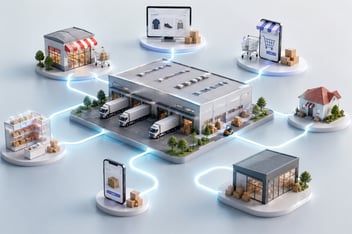
Intracity delivery network is not a single system; it is several moving parts working in tight coordination. Warehouses, riders, routing software, and fulfilment centres all have to talk to each other in real time for an order to arrive within hours. When any of these layers break down, the result is one of the most common ecommerce delivery failure causes: a late delivery that erodes customer trust. Understanding the reasons for late delivery often points back to gaps in this coordination layer rather than to any single point of failure.
The backbone is a warehouse management logistics system (WMS) integrated with a transport management system (TMS) and a real-time tracking layer across the end-to-end fulfillment chain.

3. Dark Stores: The Engine of Hyperlocal Fulfilment
A dark store is a small-format fulfillment warehouse, typically 1,500 to 5,000 sq ft, tucked inside a dense neighbourhood with no walk-in access. Its only job is to fulfill online orders fast. When a customer orders at 3 pm and expects delivery by 5 pm, the only way to honour that promise is if the stock is already nearby. A warehouse operations delay at a distant fulfilment centre makes it structurally impossible to meet that window. Dark stores make fast delivery possible by putting inventory inside the demand zone rather than outside it.
This is precisely what makes same-day and 2-hour delivery possible at scale. Quick commerce is expected to grow at over 40% annually through 2030 (bain.com), expanding beyond groceries into categories such as electronics, fashion, and general merchandise. The rapid adoption of these delivery models signals a fundamental shift in consumer expectations toward instant fulfilment.
Key capabilities of dark store operations include:
• Hyperlocal positioning within 2–3 km of demand clusters
- • Cold-chain zones for dairy, pharma, and fresh produce
- • AI-driven replenishment to prevent stockouts
- • Real-time inventory visibility to prevent dispatch delays
4. Route Optimisation and Fleet Intelligence
Speed without efficiency is just a cost. India's leading logistics operations management teams deploy AI-powered route optimisation, geo-clustering, and predictive dispatch to maximise delivery throughput. For brands asking how to improve on-time delivery rates and reduce delivery SLA breaches, this layer of fleet intelligence is typically where the answer lies. In efficient logistics networks, cost per delivery (CPD) can vary significantly depending on city, order density, and operating model.

Source: Indicative ranges based on internal analysis and industry observations; actual results may vary by category, geography, and fulfilment model.
5. Scaling Across Tier-2 and Tier-3 Cities
India's next wave of e-commerce growth is increasingly being driven by smaller cities. Tier-2 and Tier-3 markets have contributed a significant share of new online shoppers and incremental e-retail demand in recent years, while leading industry reports indicate that these markets are expected to play an expanding role in the country's digital commerce landscape. This shift is prompting brands to strengthen their fulfilment capabilities beyond metropolitan areas.
The challenge is that metro delivery models do not work the same way in smaller cities. Lower order volumes, complex addresses, and different delivery needs require flexible, asset-light networks with strong local partnerships. Delivery expectations also change from 2-hour delivery to same-day, and from same-day to next-day delivery. The brands that figure out this supply chain management and logistics infrastructure early will have a significant advantage as purchasing power and digital adoption in smaller cities continues to rise.
|
City Tier |
Network Model |
Avg. Promise |
Key Challenge |
|
Tier-1 metros |
Dense dark store cluster |
10 min - 4 hrs |
Congestion & CPD |
|
Tier-2 cities |
Hub + neighbourhood spoke |
4 - 8 hrs |
Order density for node viability |
|
Tier-3 cities |
Distributor-integrated model |
Same-day to next-day |
Address hygiene & access |
For brands, the challenge today is no longer just moving parcels, it is delivering the right product, from the right location, at the right time, while keeping fulfillment costs under control. Consumers expect same-day delivery regardless of whether they shop through a brand website, marketplace, social commerce channel, or physical store. At the same time, expansion into Tier-2 and Tier-3 cities demands a logistics model that is both scalable and asset-light. Building this capability in-house requires significant investments in warehousing, dark store infrastructure, technology integrations, fleet management, and local delivery operations. For most brands, the time and capital required to build such a network from scratch can slow down growth. For brands looking to meet today's growing demand for same-day delivery, hyperlocal fulfilment, and seamless omnichannel operations, ElasticRun's SwiftER is purpose-built to bridge the gap between rising customer expectations and the complexities of modern logistics.
Consumers no longer differentiate between online and offline channels, they simply expect faster deliveries, real-time visibility, and consistent service, whether they order through a D2C website, marketplace, social commerce platform, or retail store. Delivering on these expectations traditionally requires significant investment in warehouses, dark stores, technology, fleet operations, and last-mile infrastructure, making it a costly and time-intensive undertaking for most businesses.
SwiftER helps address these barriers by offering a plug-and-play intracity express and end-to-end fulfilment network designed to support brands in launching and scaling expedited delivery services without building logistics infrastructure from scratch. For brands navigating ecommerce fulfilment challenges, SwiftER provides ready access to warehousing, dark store capabilities, and last-mile delivery services, helping reduce the complexity of managing these functions independently. Backed by ElasticRun's pan-India network spanning Tier-1, Tier-2, and Tier-3 markets, SwiftER combines strategically located warehousing, dark store operations, intelligent inventory placement, and reliable last-mile delivery into a single integrated ecosystem.
*Delivery timelines and service commitments are subject to applicable service agreements and coverage availability.
6. Key Performance Metrics for Hyperlocal Networks
For brands and third party fulfillment operators assessing ecommerce fulfillment readiness, the following KPIs define network health and customer experience quality across Indian markets.
|
KPI |
Definition |
Indicative Industry Range |
|
On-Time Delivery Rate |
Orders delivered within promised window |
>92% (top operators) |
|
Fill Rate |
Ordered SKUs available at fulfilment node |
95-98% target |
|
First-Attempt Delivery Rate |
Deliveries completed without re-attempt |
88-93% |
|
Cost Per Delivery (CPD) |
Total delivery cost / shipment count |
Rs. 28 - Rs. 60 (varies by city) |
|
Order-to-Dispatch Time |
Mins from order confirmation to rider assignment |
<8 min (dark store model) |
|
Return Rate |
Orders returned within the return window |
<5% grocery; 15-25% fashion |
Source: Indicative ranges based on internal analysis and industry observations; actual results may vary by category, geography, and fulfilment model.
Final Thoughts
Same-day delivery in India is no longer a premium feature. It is the baseline expectation. Late delivery in ecommerce is not just an operational inconvenience, it is a direct cost to customer retention. The gap between what consumers expect and what most brands can deliver is a logistics problem and it is solvable. Brands that invest in understanding how to reduce delivery delays, and in the infrastructure to act on that understanding, are closing that gap today. They are not just fulfilling orders faster. They are building the customer loyalty that slower competitors will spend years trying to recover.